



A Mother’s Journey Forward: from Hardship to Healing
Leer en
At El Programa Hispano Católico (EPHC), we love to share stories of celebration and success: families in stable housing, children thriving in school, and elders finding connections. And we also know that many families are still on their way toward those moments, in the middle of building stability, healing from trauma, and taking courageous steps forward each day.
Today we’re sharing the story of Lucía, a mother whose journey is still unfolding, and whose strength shines even in the hardest chapters. We are deeply grateful for her generosity and courage in choosing to share her story with us.
A Journey to the US
Lucía describes herself as a quiet, cheerful woman, someone who often smiles even when she is hurting inside. Political and economic instability in her home country left her with no other choice but to flee in search of safety and a future for her children. When she first arrived in the United States, she had already survived one of the most dangerous journeys in the world. She crossed the jungle alone with her two children, carrying their food, clothing, and fear on her shoulders. “It was just me, my kids, and God,” she remembered.
When they reached the United States, the challenges did not stop. In Denver, work was hard to find. She and her partner heard there might be more opportunities in Oregon, so they came here, staying first with acquaintances and then in shelters. Eventually, the family lost their housing and began sleeping in their car.
“I never imagined I would live that … To be in the street with my children, it was very hard.”
Finding a Community that Spoke Her Language
A friend who had also been in crisis told Lucía to call 211 for help. Through those calls she was referred to EPHC. That is how she was eventually connected with a case manager who spoke Spanish and could truly listen.
Little by little, more support circled around her, staff who helped her navigate shelter options, find food, and explore resources for her work permits and tools for her children. When one of her children was diagnosed with tuberculosis and the family was abruptly pushed out of a shelter and even turned away from a medical appointment, she felt treated “like we were worth nothing.” She called her case manager in tears.
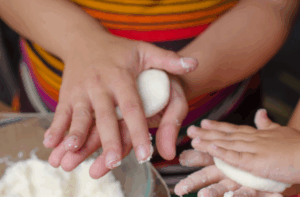 Her team at EPHC helped advocate, explain medical information, and find a hotel where she could cook for her children while they waited for test results. “My kids were happy because I could cook for them,” she reflected, they were not allowed to cook in shelters and had limited nutritional food options. “They did not want to leave [the hotel]” Even something as basic as being able to make arepas again became an act of care, dignity, and healing.
Through each setback, sudden moves, confusing rules, and long waiting lists, Lucía leaned on that relationship. She called when she needed help understanding letters, when she felt overwhelmed by the system, and when she felt ready to give up. Her case manager reassured her again, you are not alone, and your turn will come.
A Long-awaited Call Finally Came
After months of uncertainty, Lucía finally received a call, and her application for an apartment had been approved. At first, there was a mix up, someone at the shelter told her she had been denied, and her children cried in frustration. Lucía immediately started calling everyone she knew, including staff at EPHC, trying to understand what had happened.
A few days later, she got the official news, her housing had been approved after all.
She remembered the moment she signed the contract. “They told me, you do not look happy … I was happy, but my heart was still heavy because of everything happening with my daughter.” Even with that weight, she knew this was a turning point for her family.
When she received they keys to the apartment, her children jumped up, “Mami, let’s pack. Let’s go!”
They moved that same day. For a week they slept on the floor while they waited for furniture, but Lucía did not mind. That first night, she made arepas in her own kitchen. Her children were so happy they kept asking for more.
After months of shelters where she was not allowed to cook, and navigating complex medical systems, being able to be in the warmth of a home, make familiar food for her children, and sit down to eat together felt like a victory that went far beyond a meal.
“We just wanted to be out of the shelter,” she said “We just wanted a home.”
Trauma, Adolescence, and An Ongoing Journey
 Today, Lucía is deeply grateful to have stable housing, but her journey is far from over. She worries about her daughter, who is twelve and going through a very difficult and rebellious stage. Her son is starting to follow his sister’s lead.
Lucía understands that everything her children have lived, the dangerous journey through the jungle, the nights sleeping in the car, being moved from one shelter to another, being pushed out of medical spaces because of fear and stigma, has left deep marks. That trauma does not always look like sadness. Sometimes it looks like anger, resistance, or refusing to go to school.
Lucía is honest about where she is. She is not ashamed, she is asking for help loudly and bravely.
“I want to shout it to the world,” she said. “I need help with my daughter. I do not want things to get further out of control.”
Now that Lucia and her children have a home, her goals are clear: to find stable work so she can pay her own rent, to help her children stay in school, and to save what she can to someday reunite with the rest of her family. Most of all, she wants to see her children heal from everything they have lived through. Her EPHC case manager and family will continue to walk beside her through this new chapter of her life.
A message to Other Families
Even in her hardest moments, Lucía’s love for her children is what keeps her going.
“My kids are what push me forward. I do not want them to see me give up. I want them to see they have a strong mom.”
And other parents in crisis, she offers this message:
- Have patience. “Sometimes it feels like no one wants to help, but there are many cases, and some are even worse than ours. Your time will come.”
- Trust the process. “At first, I thought, they do not want to help me. Now I understand it was not my moment yet. But the support did come.”
- You are not alone. Even now, with her own apartment, she knows she can still call her case manager. “That support does not end when you get housing […] and I carry them in my heart.”
Lucía’s story is not a simple before and after. It is a story in motion, of a mother who crossed a jungle, lived outside with her children, navigated shelters where she could not even cook for her children, and is now building a new life from an empty apartment floor upward.
Her journey also reminds us of the harmful stigmas often placed on immigrant and Latine families: stigmas that ignore the structural barriers, trauma, and courage behind their experiences. At EPHC, we challenge those narratives by honoring the dignity, strength, and humanity of every family who walks through our doors.
Note:
For safety and confidentiality, the name in this story has been changed to protect the identity of the participant.
How You Can Help
Partner with us
Are you a local business or foundation? Let’s grow culturally‑specific elder services, outreach, and community arts together. Contact:
Thank you for standing with Latine families like Lucia’s.